My magnesium requirements in times of stress

12. January 2026

Magnesium and B vitamins: their importance for relaxation

When we are relaxed, we go through everyday life with more energy. We are more open to the wonderful moments of life and also feel more productive and happier. But being relaxed and staying that way is not exactly and easy thing to do. We face professional challenges and have to look after our family as well as day-to-day life. Meeting these demands can be exhausting and cause both mental and physical strain. Our health and well-being suffer as a result. Those affected feel exhausted, are irritable more quickly and often complain of tension in the neck or shoulder area.


In this situation, our body needs more important minerals and special B vitamins, especially magnesium and the vitamins B1, B2, B6 and B12. This is because magnesium is involved in muscle relaxation and the B vitamins B1, B2, B6 and B12 are of great importance for the development, functioning and regeneration of nerve cells. 

Magnesium and B vitamins for relaxation

How does stress arise?

Stress fulfils an important task: It activates a physical state of emergency that is necessary so that we can muster more energy. This enables people to respond quickly to external factors, so-called stressors (see “Good to know”). The exact factors that put us under physical and nervous strain vary greatly. The multiple stresses of everyday life or a relationship crisis are just as much a part of this as noise. Stress becomes a strain on muscles and nerves, especially if it lasts for a long time.  


Two-thirds of the population sometimes suffer from stress – a quarter even complain about it as a permanent condition. 


The associated tension puts a strain on our bodies. This can lead to muscle tension, an accelerated heartbeat and shortness of breath. Combatting these stress reactions requires more energy,  minerals and vitamins. 

Good to know: Stress is triggered by “stressors”. These can be physical factors such as heat and cold but also hectic conditions or noise. The main psychological stressors are time pressure, unresolved problems such as financial worries and social conflicts.

What happens in the body under stress?

In order to be able to react as quickly as possible to stress, our body “shifts up a gear”. This response is triggered by stress hormones such as adrenaline and cortisol, which cause our blood pressure to rise and our heartbeat and breathing to accelerate. This improves the oxygen supply to the muscles and brain. At the same time, our muscles are tense. Stress particularly affects the neck and shoulder area.

Why does the body need more magnesium under stress?

When we are stressed, this often manifests itself in physical tension. The muscles contract, sometimes causing painful tension in the shoulders and neck, for example. As magnesium is involved in muscle relaxation, it is important to ensure a sufficient supply of magnesium in stressful situations. The elevated release of stress hormones also leads to elevated excretion of magnesium.


At the same time, it is important that the body can relax again after a period of tension. After a stress reaction, the blood pressure should drop again, and the heartbeat and breathing should also slow down. This requires magnesium. This is because the mineral is involved in the regulation of stress hormones. It also reduces the excitability of nerve cells. In this way, magnesium helps the body to switch from tension to relaxation. The stress can subside again. However, this requires a sufficiently filled magnesium reservoir.

Why can B vitamins help with stress?

B vitamins – including B1, B2, B6 and B12 – have different functions in our body. They contribute to the conversion of food into energy, support the function of the nervous and immune systems and are involved in the formation of red blood cells and the regeneration of nerve cells.


These vitamins are increasingly needed in the event of prolonged stress. This is because the body needs B vitamins to produce stress hormones such as adrenaline and serotonin. It is therefore important that our body is sufficiently supplied with B vitamins, especially in stressful situations.

How does a combination of magnesium and special B vitamins support our ability to relax?

When we are under stress, our body needs more resources. Anyone who is often under stress in everyday life should therefore provide their body with sufficient vitamins and minerals. This is the only way he can return to a state of rest, the only way muscles and nerves can relax again. Magnesium and B vitamins are essential here – they each fulfil important functions and complement each other: 


  • Magnesium supports normal muscle function. 
  • Vitamin B1 contributes to normal energy metabolism, normal function of the nervous system, normal mental function and normal heart function. 
  • Vitamin B2 is involved in normal iron and energy metabolism. 
  • Vitamin B6 supports normal energy metabolism, the normal function of the nervous system, normal protein and glycogen metabolism, the normal function of the immune system and the normal formation of red blood cells. 
  • Vitamin B12 contributes to normal energy metabolism, the normal function of the nervous system and the immune system, and the normal formation of red blood cells, and it also has a function in cell division.
PRODUCT RECOMMENDATION

Magnesium-Diasporal® pro Muscles and Nerves

High-dose magnesium combined with vitamin B complex to support normal muscle and nerve function – ideal in stressful times. Just one daily dose.

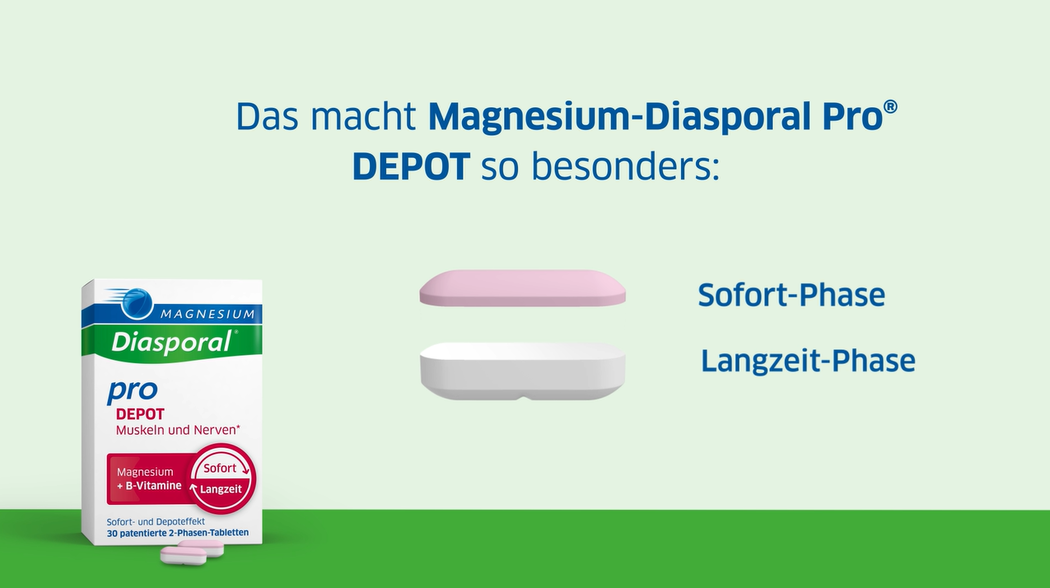
Good to know: The patented 2-phase tablet Magnesium-Diasporal® Pro DEPOT Muscles and Nerves has two tablet layers that work in accordance with the principle of rapid and time-delayed continuous release. The instant phase contains fast-acting magnesium as well as vitamins B2 and B12 for rapid release. In the sustained-release phase with sustained-release magnesium and vitamins B1 and B6, the release is delayed over several hours.

Explanatory video Magnesium-Diasporal® Pro DEPOT Muscles and Nerves

video-preview
My Magnesium

Magnesium in every situation

Magnesium requirements are elevated in many situations. It is then particularly important to have sufficient intake in order to continue to feel well and be healthy.

Social media

Find out more…